
What Is a ZK Private Swap? Zero-Knowledge Swapping Explained
Most swaps are loud. You send an asset from a wallet, a router moves it, and the whole path is written to a public ledger that anyone can read forever. Balances, amounts, timing, counterparties — all of it becomes searchable by block explorers, analytics firms, and anyone who happens to know one of your addresses.
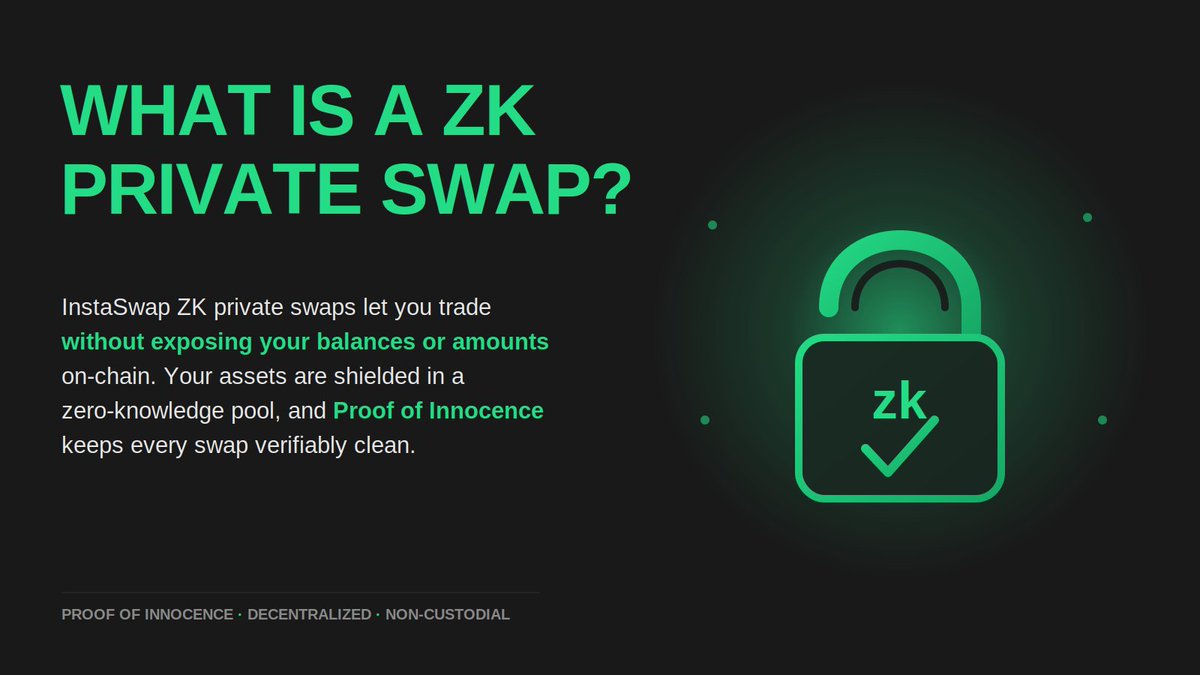
A ZK private swap is the answer to that. On InstaSwap, it lets you trade without exposing your balances or amounts on-chain. Your assets are shielded inside a zero-knowledge pool, and Proof of Innocence keeps every swap verifiably clean.
What "zero-knowledge" actually means here
A zero-knowledge proof is a piece of cryptography that lets you prove a statement is true without revealing the data behind it. The classic framing: you can prove you know a password without ever typing it out.
Applied to swapping, the statement is roughly: "I deposited a valid amount into this pool, I have the right to withdraw it, and I have not already withdrawn it." The network can verify that proof mathematically. What it never learns is which deposit is yours.
How a ZK private swap works, step by step
- 1. Deposit. You send your funds to the swap. Nothing unusual happens here — this is an ordinary on-chain transfer.
- 2. Shielding. The funds enter a zero-knowledge shielded pool. From this point forward, the public ledger sees a pool, not a person.
- 3. Proof generation. A short proof is produced that establishes your right to the output without identifying your deposit. This is why a ZK route takes a little longer than an instant public swap: cryptography has a cost, and that cost is measured in seconds, not hours.
- 4. Delivery. The output is paid to the address you specified, with no public link back to the wallet that funded the swap.
The result is a swap that is confidential to the public but provable to you. You keep records of what you did. Observers do not.
Proof of Innocence: privacy without the grey area
The historical objection to privacy tooling in crypto has always been the same: if nobody can see anything, how do you keep bad actors out?
Proof of Innocence answers that directly. It is a cryptographic attestation that the funds in your swap do not originate from a set of known-illicit sources — and, crucially, it proves this without revealing your transaction history. You are not handing over your financial life to prove you are not a criminal. You are proving one specific claim, and nothing else.
That is the difference between privacy and opacity. Opacity hides everything from everyone. Privacy hides what should be private while still allowing what needs to be proven to be proven.
What stays private — and what does not
It is worth being precise, because privacy tooling is often oversold.
- Private: the link between your funding wallet and your receiving address, your balances, and the amounts as they relate to you specifically.
- Still public: the existence of the pool itself, and the fact that a deposit and a withdrawal occurred. Blockchains are public infrastructure; a shielded pool changes what observers can conclude, not whether they can see blocks.
- Still your responsibility: operational security around it. If you withdraw a distinctive amount to an address that is already publicly tied to your name, cryptography cannot save you from yourself.
Where you can use it
ZK-proof settlement is not a separate product tucked away in a corner. It runs across the InstaSwap surface:
- Single swaps. Toggle Private on a pair and pick the route that fits your trade-off between speed and shielding.
- Split Swap. One deposit fanned out to as many as 100 wallets, each with its own amount, settled through the shielded route.
- Payments. Pay up to 100 recipients in a single private operation, funded by whichever asset you happen to hold.
No account, no KYC, no custody
The privacy layer would not mean much if you had to hand over your identity to reach it. You do not. InstaSwap is accountless and non-custodial: there is no sign-up, no wallet connection required, and no point in the flow where the platform holds your keys. The shielded route is simply another settlement path on the same rails.
ZK private swap vs. private swap
InstaSwap offers two related but distinct privacy routes, and it is easy to confuse them.
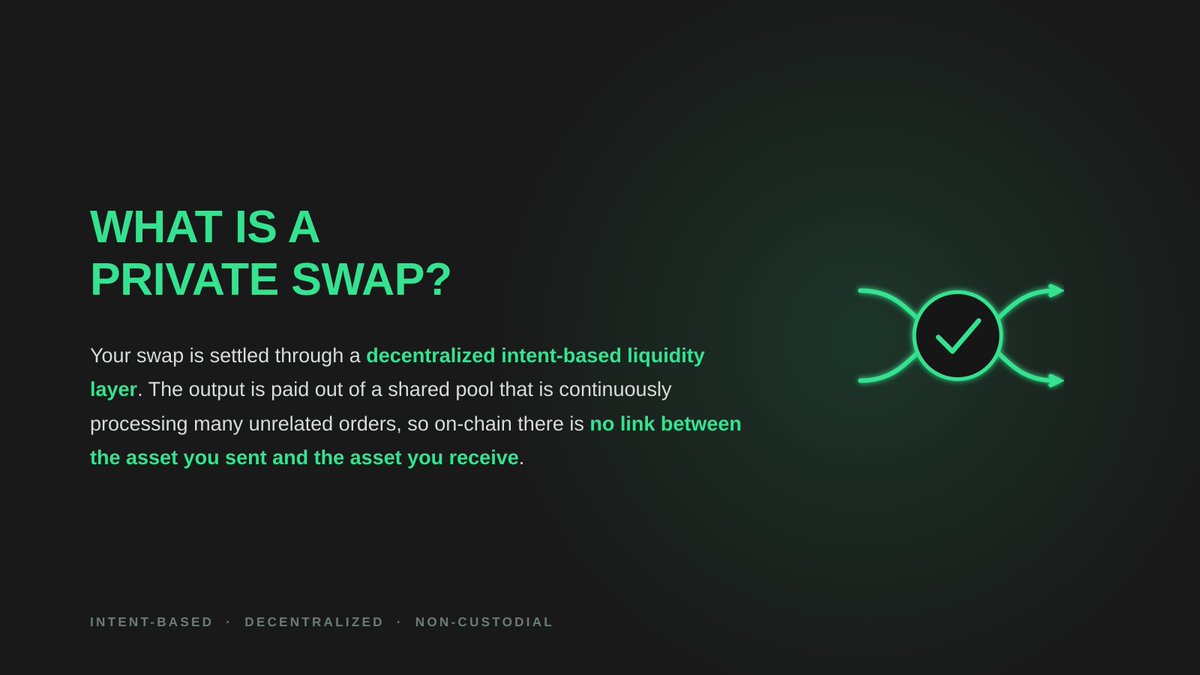
A private swap breaks the link between what you sent and what you received by settling your order through a decentralized intent-based liquidity layer, where your output is paid from a shared pool processing many unrelated orders. A ZK private swap goes further, shielding balances and amounts inside a zero-knowledge pool with a cryptographic proof attached.
Different mechanisms, different trade-offs in speed and coverage, same goal. If you want the full picture, read What Is a Private Swap? next.
Frequently asked questions
Do I need an account or a wallet connection?
No. There is no sign-up and no KYC, and you are not required to connect a wallet to swap. You provide a receiving address and the swap settles to it.
Why does a ZK swap take longer than a normal one?
Because a proof has to be generated before delivery. It is a short window measured in seconds, and it is the price of the shielding — there is no way to get cryptographic privacy for free.
Which tokens support it?
Every token InstaSwap lists can settle through the zero-knowledge shielded route. That was the point of the launch: privacy that is not restricted to a handful of pairs.
Can I still prove what I did?
Yes. Settlement is confidential to the public but provable to you. You keep records you can disclose selectively if you ever need to — to an accountant, a counterparty, or anyone else you choose.
Is a ZK private swap the same as a mixer?
No. A mixer pools funds indiscriminately and offers no way to distinguish clean funds from illicit ones. A ZK private swap carries a Proof of Innocence, which is precisely the attestation a mixer cannot give you.
Try it
ZK-proof swaps are live across every token InstaSwap lists — see the launch announcement for the details. To use one, head to app.instaswap.com, flip the Private toggle, and swap.