
What Is a Private Swap? Intent-Based Settlement Explained
Here is what a normal on-chain swap looks like to anyone watching: address A sent 4.2 ETH, and four seconds later address B received the equivalent in USDC. The two are connected by a transaction anyone can follow. Do that a few times and a reasonably competent analyst can map your wallets, your holdings, and your habits.
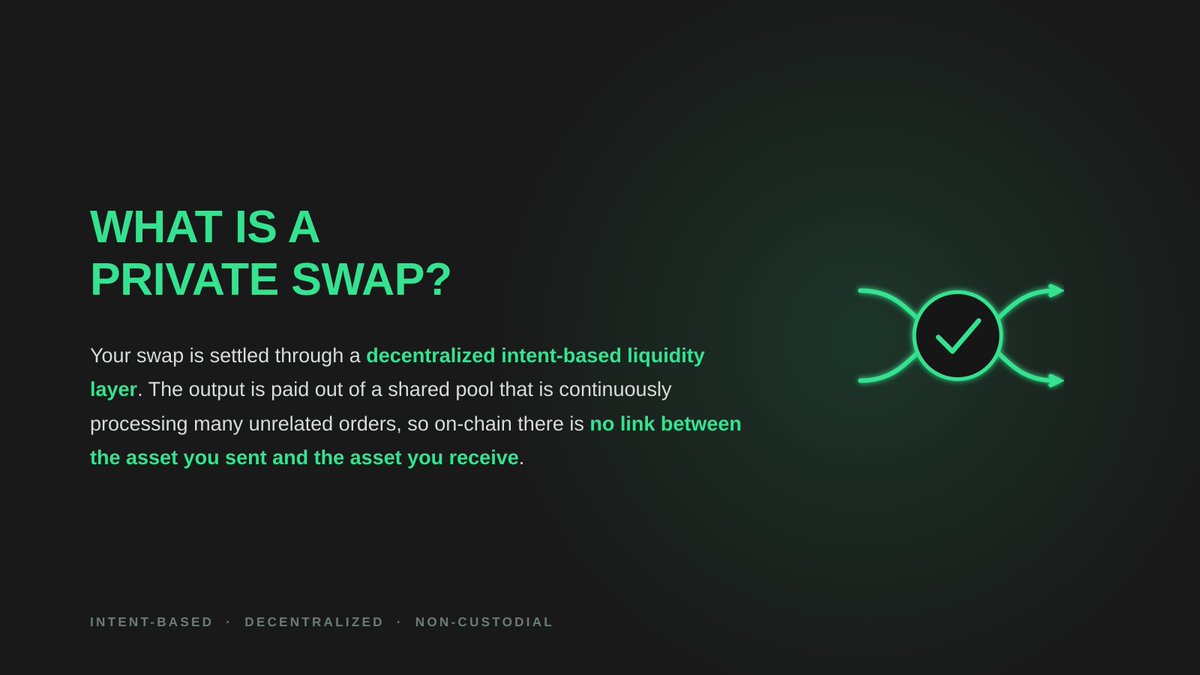
A private swap removes that connection. Your swap is settled through a decentralized intent-based liquidity layer. The output is paid out of a shared pool that is continuously processing many unrelated orders, so on-chain there is no link between the asset you sent and the asset you receive.
Intents, not instructions
The mechanism turns on a distinction that has quietly reshaped DeFi over the last few years: the difference between a transaction and an intent.
A transaction is an instruction. It says: route these exact tokens through this exact contract in this exact order. Every step is specified, and every step is therefore visible.
An intent is a statement of outcome. It says: I have this, I want that, at or above this rate. How the outcome is achieved is left to a competitive layer of solvers and liquidity providers. Because the path is not baked into your instruction, the path is not a trail leading back to you.
The shared pool is the point
Intent-based settlement is what makes the unlinkability possible. Your order does not sit alone in a lane of its own; it joins a stream of unrelated orders being settled out of shared liquidity, continuously.
When the output reaches your receiving address, it is not your tokens arriving after a journey. It is a payout from a pool that has been fed by, and is paying out to, many parties at once. There is no on-chain edge from your deposit to your withdrawal, because no such edge was ever created.
This is why privacy of this kind is a collective property rather than an individual one. The larger and busier the pool, the less any single order stands out. Cryptographers call it an anonymity set. In plain terms: a crowd works better than a disguise.
What a private swap gives you
- No public link between input and output. The core guarantee, and the reason to use it.
- No wallet fingerprinting across trades. Repeat swaps do not accumulate into a profile of one address.
- Rate competition, not a privacy tax. Because settlement is intent-based, solvers compete for your order. Privacy here is a property of the routing, not a premium line item.
- Non-custodial throughout. Funds settle to the address you nominate. There is no account holding a balance on your behalf.
Why anyone would want this
Financial privacy has an image problem in crypto, and it is largely undeserved. The everyday reasons are ordinary ones:
- A business that pays suppliers on-chain does not want competitors reading its supplier list, its volumes, and its margins off a block explorer.
- A salaried worker paid in stablecoins does not want colleagues who know one address to know their entire net worth.
- A trader building a position does not want the position front-run because the accumulation is visible in real time.
- Anyone receiving a payment from a stranger does not want to hand that stranger a permanent window into their finances.
None of these people are doing anything unusual. They just want the default level of privacy that a bank transfer has always offered, on rails that happen to be public by design.
What it is not
Two honest caveats, because privacy tooling is routinely oversold.
It is not invisibility. The blockchain still records that transactions occurred. What changes is what an observer can conclude from them — specifically, that they can no longer connect your input to your output.
It is not a substitute for your own operational security. If you send funds from an address publicly tied to your name and withdraw to another address publicly tied to your name, no settlement layer can undo that. Privacy at the protocol level and privacy at the habit level have to work together.
Private swap vs. ZK private swap
InstaSwap runs two privacy routes, and they solve overlapping problems in different ways.
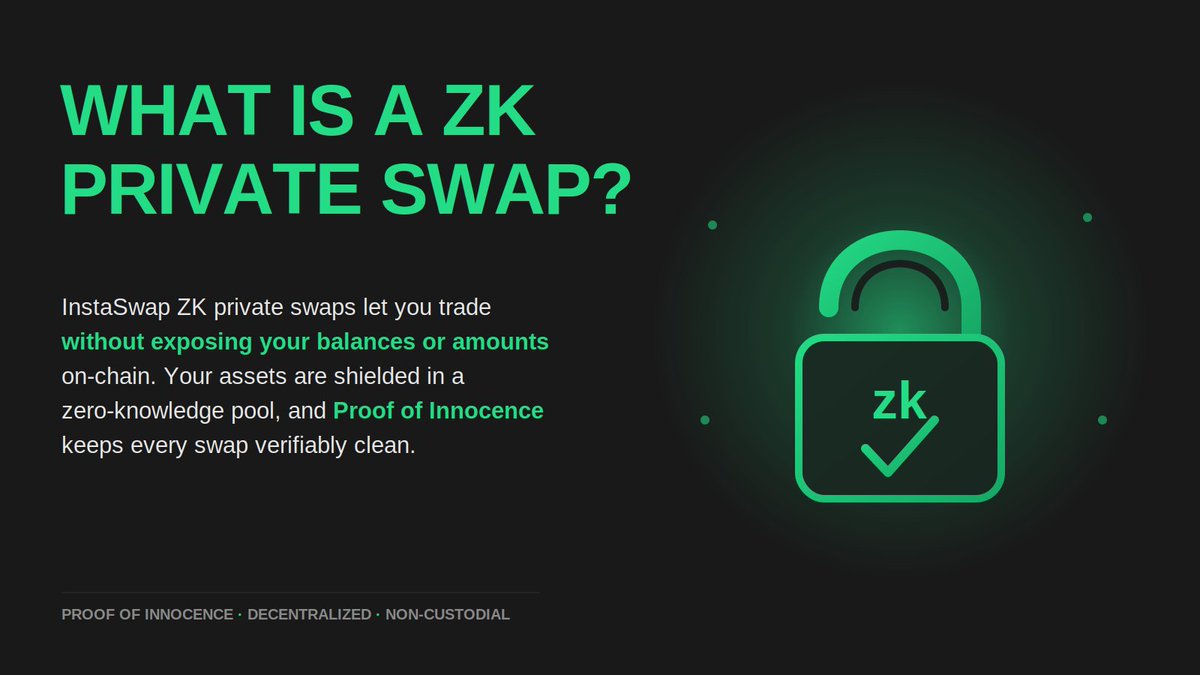
A private swap uses intent-based settlement and shared liquidity to break the input–output link. A ZK private swap shields balances and amounts inside a zero-knowledge pool, with a Proof of Innocence attached that keeps the swap verifiably clean without exposing your history.
Which to choose depends on what you are optimising for: speed and coverage, or the strongest cryptographic shielding available. Both are non-custodial, both are accountless, and neither requires KYC. There is a full breakdown in What Is a ZK Private Swap?
Frequently asked questions
Is a private swap slower than a normal swap?
Marginally, and usually not in a way you would notice. Your order has to be matched and settled out of the shared pool rather than routed straight through, which adds a small amount of time to the flow.
Does it cost more?
Privacy is not billed as a surcharge. Because settlement is intent-based, solvers compete to fill your order, and that competition works in your favour on the rate.
Do I need to connect a wallet?
No. InstaSwap is accountless and does not require a wallet connection or KYC. You supply a receiving address and the swap settles to it.
Which is stronger, a private swap or a ZK private swap?
A ZK private swap offers the stronger cryptographic guarantee, because balances and amounts are shielded inside a zero-knowledge pool rather than merely unlinked. A private swap is the faster, broader option. Both break the public connection between your input and your output.
Can I use it for paying multiple people?
Yes. Split Swap fans a single deposit out to as many as 100 wallets with individual amounts, and Payments covers up to 100 recipients in one operation.
Try it
Private swaps are live now. Go to app.instaswap.com, turn on the Private toggle, and make your first one — no account, no wallet connection, no KYC.